A deal memory that builds itself and shows its work
I was the only designer at Capwave, an AI platform for venture funds: it reads every deck, email and meeting the fund receives, remembers what was decided and drafts the follow-up. Most of what investors read in it is written by AI, so my job was making that writing easy to trust and quick to read, from the first minute of a trial to some of the code that shipped it.
Everything a fund knows lives in someone’s inbox
A partner at a venture fund runs around forty deals, thirty portfolio companies and several calls a day. What they learn arrives in pieces: the deck by email, the numbers in a founder’s update, the real story on a call.
Keeping a CRM up to date means typing all of it in by hand. So what a fund knows ends up in one partner’s inbox, notes and memory, and a colleague who joins the deal later has to ask.
We heard this problem directly from investors, in product demos and from the funds in our beta. They mostly asked for features. Each decision on this page starts from one of those requests and the problem underneath it.
Make the AI’s memory easy to trust
Capwave builds that memory for the fund from everything that comes in. I was the only designer on a team of seven, working directly with leadership and the developers on a young product. I turned investor feedback into design decisions: what the real problem was, which options we had and which one to build. I also owned the decision records, Figma, the design system and some of the front-end code.
The question I kept coming back to: how much should the AI show its work, and where? Show too little and nobody trusts it. Show too much and nobody reads it.
AI fills it in, people correct it
- What comes in
- Emails, decks, call transcripts and founders’ updates, plus anything the team types in.
- What Capwave does
- Finds the pitches, pulls out numbers and promises, scores every deal against the fund’s mandate, and writes a brief before and after each call.
- What the fund gets
- A whole workspace, organised for them: incoming pitches ranked by fit, a pipeline from first contact to closing, a portfolio of every company they’ve backed and a brief for every meeting. Behind each company sits a deal sheet with its metrics, founder promises, team to-dos, files and email history, all shared across the team.
It starts with the first fifteen minutes of a trial.
Connecting the inbox is required
Connecting email was optional, and people who skipped it landed in an empty product, with a request to connect on every page.
Every page runs on the inbox, so I made connecting a required step and removed the scanning screen. People go straight in while Capwave reads their inbox.
One example per page during the first scan
The first scan takes at least fifteen minutes, and the whole app depends on it. People in the beta didn’t know what to expect and had nothing to keep them engaged.
A full demo workspace meant fake data to maintain everywhere. One example per page, in the real layout, teaches each page at a fraction of the cost.
Tips teach each page on its example
Instead of a product tour, each page shows one or two tips on the first visit, pointed at its example. By the time real data arrives, people already know how the page works.
Then the AI starts reading for them: every pitch, every call, every founder’s update.
Fit scores with reasons
Every pitch gets a score against the fund’s criteria. In demos, investors kept asking where it came from: a bare number gave them nothing to check.
So I made the score explain itself. Hover it and you see what fits the fund’s criteria, what doesn’t.
Every call starts prepared
Calls are at the centre of an investor’s job, often several a day, and the context for each one is spread across emails, decks and earlier calls.
A brief before each call brings it together. After the call, a second brief keeps what was said and decided.
Founders’ updates, turned into work
Founders send investors regular updates with numbers, wins and asks. Across thirty portfolio companies, investors told us they kept losing track of what founders had asked for or promised.
Capwave pulls the to-dos and commitments out of each update and keeps them on the company’s page.
Founders keep sending numbers long after the first call.
Metrics with a history
Investors kept telling us they couldn’t see how a company was doing over time. Each metric showed only its latest value, so the only way to see growth was to dig through old decks and emails.
Now every number a founder sends joins the metric’s line, each point linked to its source.
Highlighted metrics on every deal
Investors told us a deal in the pipeline and a company in the portfolio are judged on different numbers, so one fixed set of metrics fits neither.
A fund picks up to four highlights per stage. They lead every deal sheet, so investors see what matters without opening a single metric.
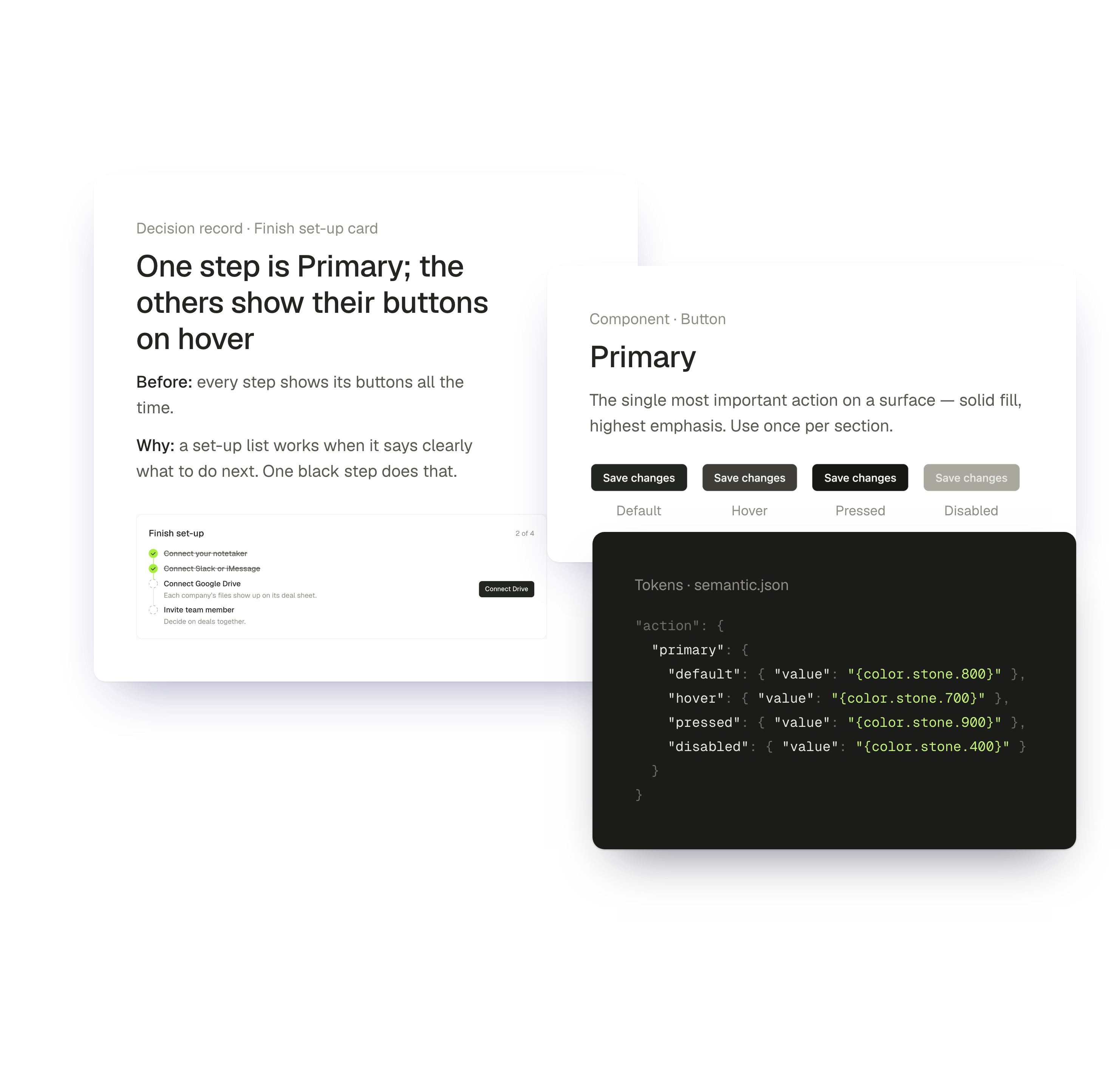
Under these screens are the tokens, components, decision records and code I built them from.
That part has its own case study: one design system for two products, decision records written for developers, the front-end I shipped myself, and how the AI I design with learns from my corrections. Under the hood of Capwave →
Live in beta, opening to all funds
Capwave is in beta with its first venture funds. The next step is opening the platform to every fund that wants to join.
With that launch, measurement becomes the focus. Real usage data will show how well each decision on this page answers the investor feedback behind it, and where the design should go next.
Owning the product, not just the screens
Find the problem behind the request. “More metrics” really meant “I can’t see if this company is growing”, and that became the metric history. I now start every request by asking what it’s trying to fix.
Write down the why, not just the what. For each decision I wrote a short record: the problem, the options and why we chose one. Developers built from it without waiting for me, and the product stayed consistent as it grew.
Trust is designed, not added. A fit score without reasons gave investors nothing to check. In an AI product, sources and reasons aren’t extras; they decide whether people rely on it at all.
The tokens, components, decision records and code behind Capwave.
View case study